Oct 26, 2026


Wiley Partners With Radical AI To Superpower Materials Scientists
High-quality data is a foundation for rigorous experimentation in the first AI-powered self-driving lab.
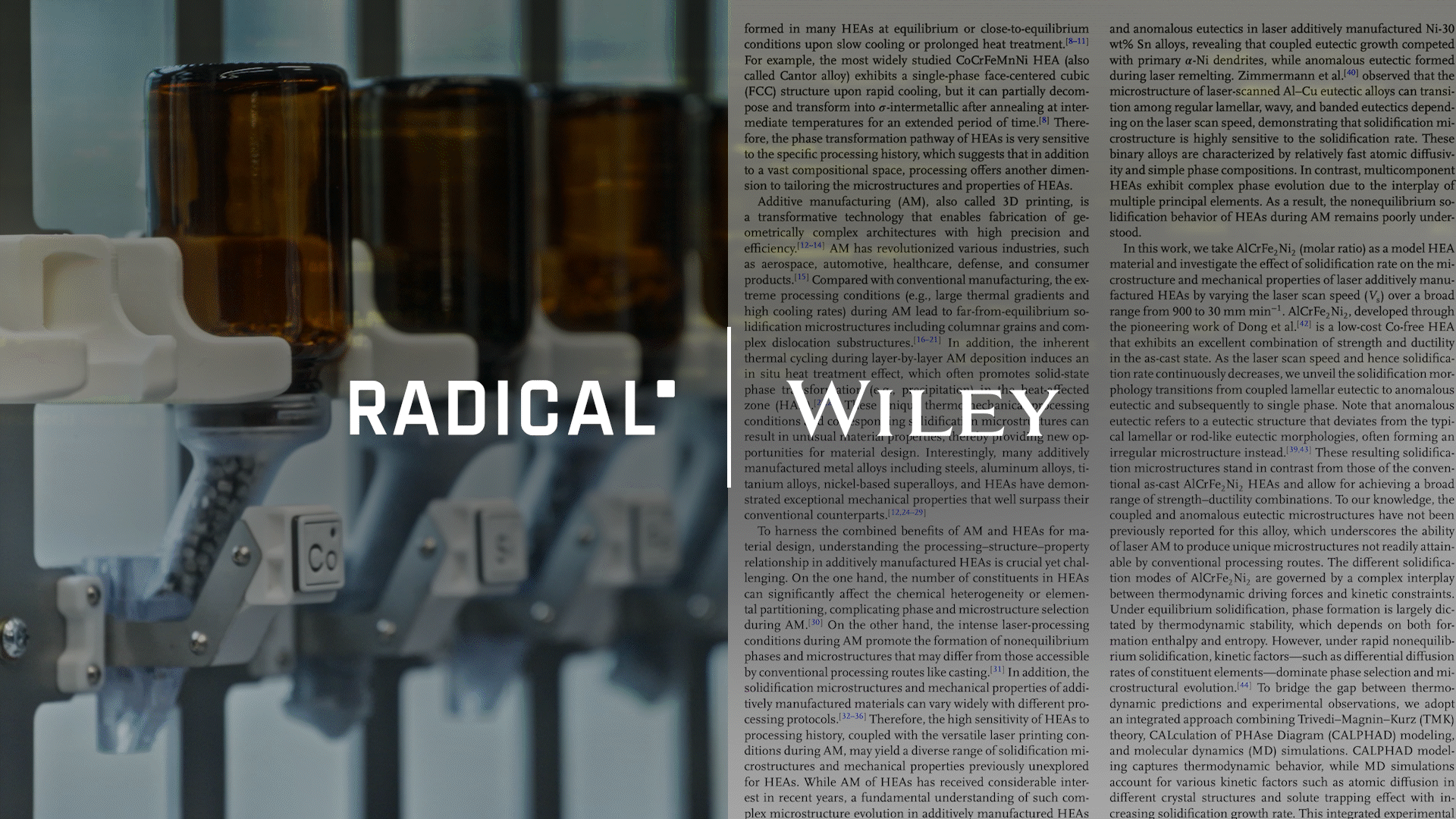
Radical AI’s self-driving labs are enabling a new speed of science, but doing so in deep collaboration with the institutions that shaped the field, from national laboratories to top academic and scholarly publishers.
One such partnership is with the academic publisher Wiley. Radical AI references hundreds of thousands of papers every time it generates hypotheses for novel materials that are then synthesized and studied in the self-driving lab. A substantial portion of those are sourced via a collaboration with Wiley.
Building the Future—With Strong Foundations
As AI becomes more deeply integrated into scientific research, the quality and provenance of information have become increasingly important. Researchers need confidence that AI-generated outputs can be connected back to credible evidence and that recommendations are grounded in transparent, verifiable sources.
Radical addresses this in two ways: First by referencing literature and experimental data, then by testing the most promising hypotheses in its self-driving lab.
When a materials scientist inputs their target performance qualities, the long-horizon agent taps Wiley papers (as well as those from other academic publishers and open-source providers) for Retrieval-Augmented Generation (RAG), referencing relevant papers and documents to understand what has been done before and which novel compositions might be most promising. The system also references 70 million data points already generated from synthesis and characterization in the self-driving lab.
Then, most crucially, the self-driving lab tests those AI-generated hypotheses through real synthesis and characterization. As candidate materials move through the lab, automated stations record data spanning composition, processing conditions, crystal structure, microstructure, density, hardness, stiffness, oxidation resistance, and more. This all feeds back into the AI to further fuel fast discoveries.
Driving Real Results, Faster
The process is working today: In initial campaigns aimed at discovering new materials to better serve the demands of hypersonic applications, Radical generated 300+ novel materials and outperformed the current industry-leading material in 16 weeks. As a point of comparison, the entire field has only experimentally studied 3,493 unique alloys in this space over 20+ years.
See the case study we published with Wiley here.