Jun 9, 2026


Automated Microstructure Analysis Moves Different
How a trove of 10,000 SEM images changes the way we conduct science in the world's most advanced materials science lab.
By Keithen Orson
The biggest challenges in building agentic self-driving labs aren’t just a matter of automating tools. At Radical, we spend much more time making data actionable—this is the work that really enables breakthrough discoveries.
Take, for example, the annealing process. The experiments we are running today require us to heat samples up to 1,500°C to “mix” the elements, but samples don’t all need to be “baked” the same amount of time. To optimize the process, you need to know how long to anneal each sample. Too little annealing time and the material isn't homogenized. Too much and you've wasted days or weeks. To determine annealing time, we need to measure secondary dendrite arm spacing (SDAS) from scanning electron microscopy (SEM) images. Measuring it, until recently, was a manual job.
We’ve now created what we believe to be a first-of-its kind automation system that speeds, standardizes, and scales our ability to interpret the microstructure of alloy SEM images to direct the flow of samples for annealing. This is exciting not just for how it makes the lab run faster, but more importantly the clean, controlled data set it presents. These structured images let us directly compare all our samples, better understand how all the properties across a very wide dataset link to microstructure, and discover performant materials faster than ever before.
The Manual Baseline
During my PhD I spent many hours measuring particle size and labeling microscope images by hand. This step is normally needed to calculate important statistics like SDAS.
You open an SEM image, identify the dendrite arms, draw a line across them, count the arm intercepts, divide, then repeat. (It takes specialists about 15 minutes per image.) Repeat for each image.
This human method also obviously introduces variability. If you give the same task to two scientists, their measurement can vary by ± 16%. Across a corpus of thousands of images and samples, it becomes a systematic source of noise.
SDAS governs how far atoms need to diffuse for the alloy to homogenize. Larger spacing means atoms need to diffuse farther, which means longer annealing time. Shorter spacing means you can pull samples out of the furnace sooner. In practice, optimal annealing time can range from a few hours to several days or even weeks depending on the sample.
Without SDAS data, the conservative approach is to run all samples through your furnace at the maximum time. At a small scale, this is a reasonable tradeoff. At our level of throughput, it compounds into large inefficiencies we can’t accept.
What We Built
We've been running our automated lab for about nine months and have collected over 10,000 SEM images. This is a dataset is orders of magnitude larger than what I had access to in my PhD, and made our microstructural analysis possible.
I am also now surrounded by a very different kind of team. Materials science labs don't typically include software engineers and machine learning experts alongside researchers. Ours does. Working with colleagues who specialize in software, physics, and math, we built a system that automatically detects the relevant microstructural regions in each image, extracts dendrite geometry, and calculates SDAS across the full image rather than from a single hand-drawn line.
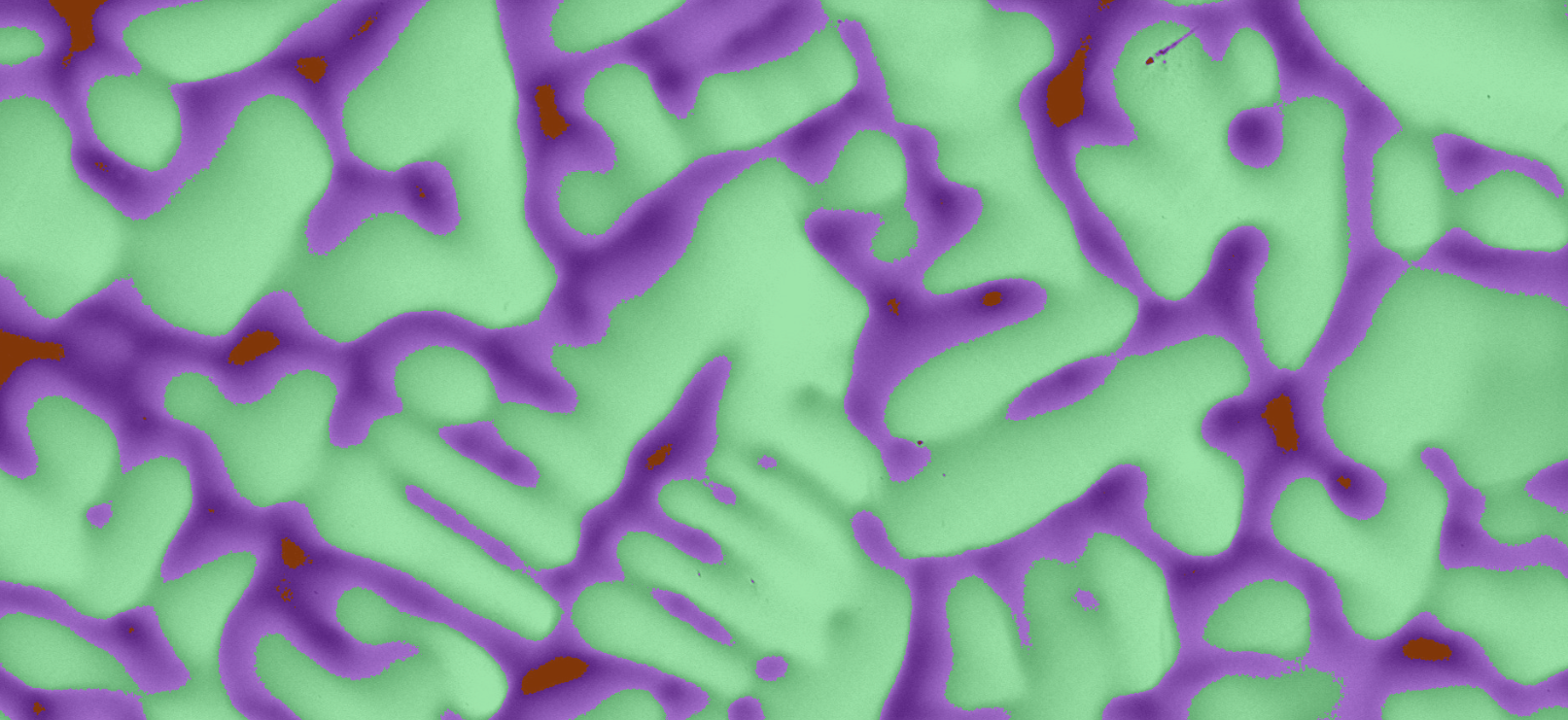
We identify dendrite arms using a segmentation model, then measure the spacing by computing the distance between each arm in an image, and then repeat that for every image. The entire process takes about a second per image on a personal computer.
What This Changes
In the near term, this gives us consistent SDAS measurements across the full image corpus, with structured data feeding back into the platform.
Consistency matters as much as speed: When every measurement follows the same method, comparisons across samples are meaningful in a way they aren't when manual measurements carry operator-to-operator variance.
Longer term, SDAS becomes an input for annealing time selection as we scale processing in our new lab at Building 20. When furnaces run samples optimized to their actual microstructure, rather than to a conservative maximum, we can cut years of idle time out of our operation.
The broader point is about what proprietary data at scale actually enables. One materials scientist can measure SDAS for a few alloys. A team of scientists and software engineers with 10,000 images can turn that measurement into a reproducible, automated workflow that feeds directly into material processing decisions.