Mar 9, 2026


Beyond Composition: Computing What Materials Will Actually Do
Bringing together computational chemistry expertise and scaled modern infrastructure to pave a massively more accurate discovery pipeline.
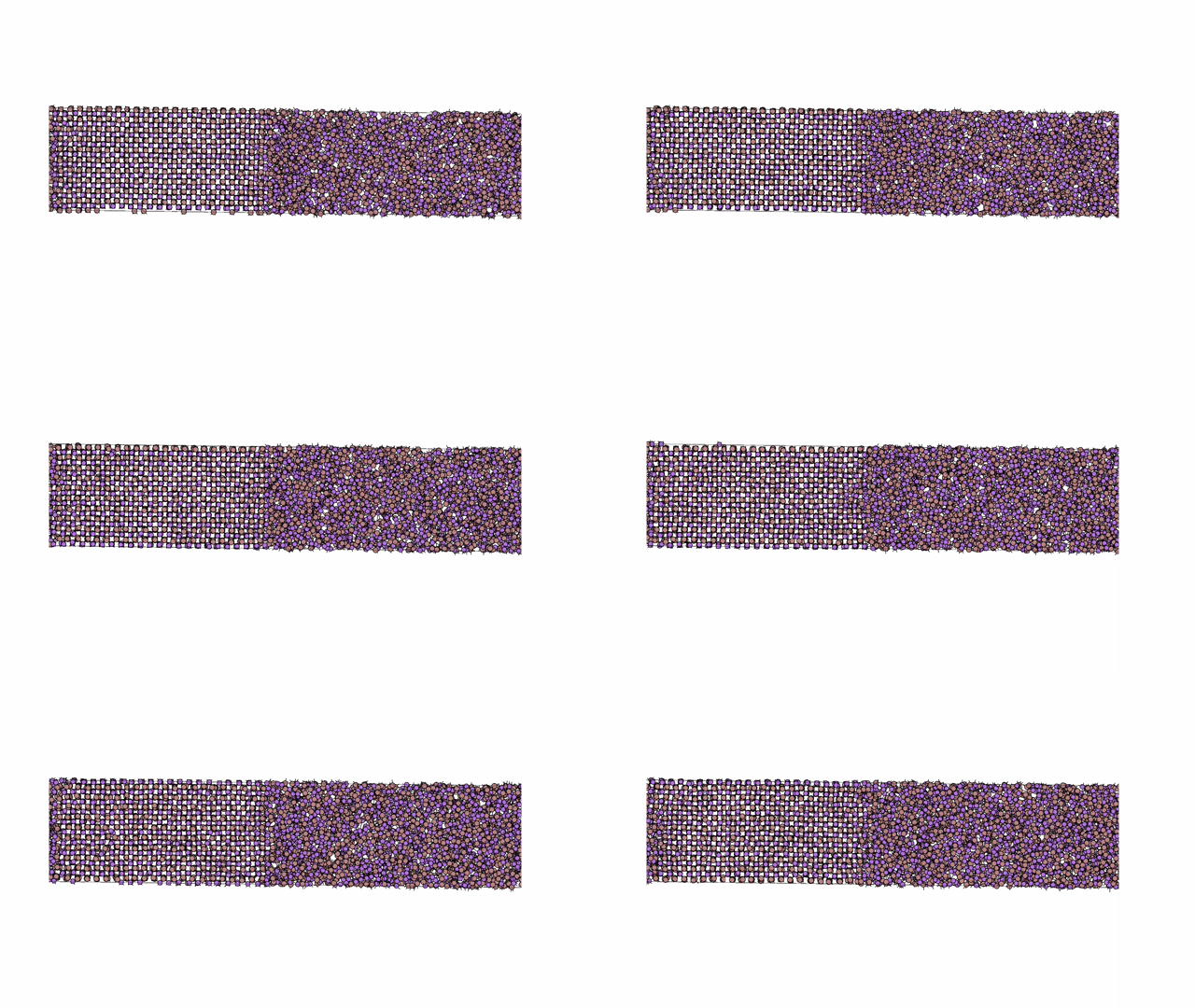
Most approaches to materials property prediction take the same shortcut. They map a composition directly to a target property. It's faster, cheaper, and reflects the deep divides between academia and the capabilities of modern software engineering.
A material's properties are not determined by its composition alone. They're determined by its structure: by how atoms are arranged in three-dimensional space. Two alloys with identical compositions can behave completely differently depending on how their elements are distributed across the crystal lattice. Bypassing structure elucidation to get to a property faster produces predictions that fail at the boundary between simulation and synthesis.
Prediction isn't progress until it's proven in the lab, and our team’s work implementing rigorous and comprehensive computational recipes within a scalable and transparent KubeRay infrastructure helped generate predictions that are more likely to work when alloyed in our lab. By breaking down complicated structure-aware workflows into small task units that can be deployed across modern computing platforms in a reproducible software environment, we can do better property simulation and deploy models as a service. We used our internal Machine Learning Interatomic Potentials (MLIP) model EGIP to derive properties customers care about, and see this works especially well when fine-tuned on datasets for a specific class of material, in this case multi-principal element alloys (MPEAs).
The Challenge
MPEAs, high-entropy alloys composed of multiple elements in roughly equal proportions, are among the most promising material classes for extreme-condition applications. The challenge is that the chemical space is enormous: on the order of 10⁶ candidate compositions. Screening that space through physical experiments alone isn't feasible. Simulation is the only way to narrow down a solution set worth bringing into a lab.
The standard approach models MPEAs as random alloys: given multiple elements, assume each atom has an equal probability of occupying any site in the lattice. This is a reasonable approximation. It is not always a correct one.
Short-range ordering changes things. In practice, certain elements have preferences: They want to sit next to specific neighbors, not be distributed randomly. That ordering can meaningfully affect the properties that matter to our customers: melting point, yield stress, ductility, density, castability. Models that ignore it produce predictions that diverge from what will prove out in experiments. We factor it in.
The second challenge is structural. Moving from composition to structure to property requires workflows that are expensive, sequentially dependent, and deeply domain-specific. The expertise to design them—to know which computational steps are scientifically meaningful, which dependencies can be parallelized, how to write tests that actually test the chemistry—sits at the intersection of two fields that have, until recently, operated in entirely separate worlds.
Academic computational chemists carry deep intuition about the physical problem. They are not, by training, distributed systems engineers. Software engineers who are experts at building reproducible, scalable workflows lack the domain knowledge to know which parts of a materials simulation can be safely parallelized and which can't, or what a scientifically meaningful failure mode looks like.
We are among the few teams building at the intersection of both. The computational chemists and software engineers at Radical work on the same problems, in the same environment, until the boundary between their disciplines starts to dissolve.
What We Built
The core requirement of this project was to break complex, structure-aware computational chemistry workflows into discrete task units that can be deployed reproducibly across modern computing infrastructure.
We chose KubeRay. It maps cleanly to Python, deploys across major cloud providers, and its Actor model lets us distribute large-scale simulations efficiently and serve our ML models as persistent services rather than reinitializing them for each job. Moving from large shared scripts to orchestrated task units also gives us something that traditional computational chemistry workflows don't have: granular telemetry. We know exactly where compute time is going, which enables optimization of task placement across heterogeneous hardware.
For property computation, we use our internal machine learning interatomic potential, EGIP. MLIPs have reached a point where, fine-tuned on domain-specific datasets, they approach Density Functional Theory (DFT) accuracy at a fraction of the cost. For MPEAs specifically, we've built proprietary training data that generic models don't have access to.
The properties we compute go beyond what most of the field attempts:
- Melting point: large-scale molecular dynamics simulations modeling the actual solid-liquid transition, not rule-of-mixtures approximations.
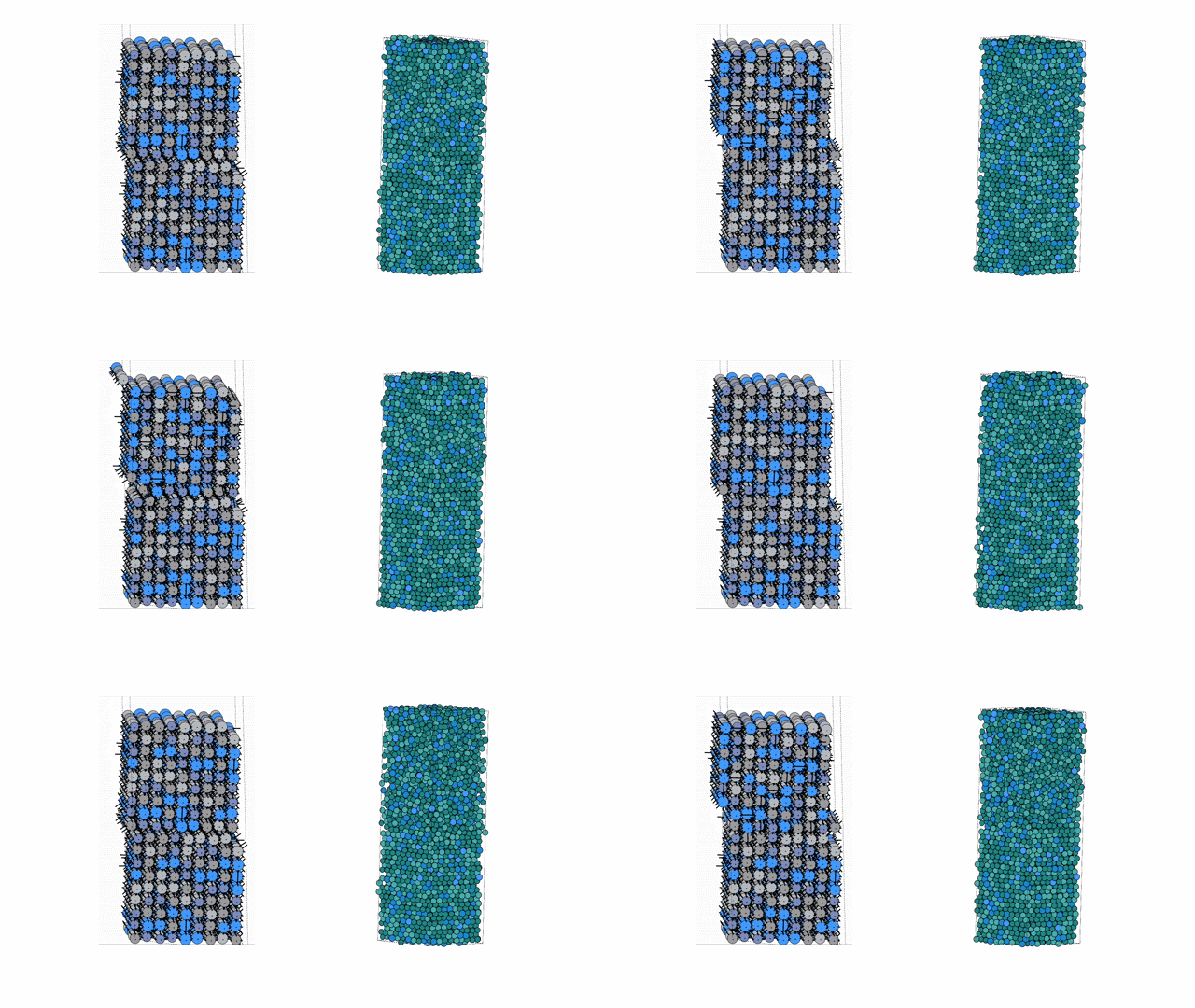
- Ductility: simulated by modeling large sheared structures along their most likely slip systems. Most approaches in this class of materials use rule of mixtures, or at best a surrogate model trained on a narrow compositional subsystem and not generalizable beyond it.
- Yield stress: computed by modeling the variation of atomic volume across the compositional subsystem and deriving yield stress analytically from misfit volumes. Again, not rule of mixtures.
- Density and castability complete the picture, giving customers what they need to make manufacturing decisions, not just isolated property values.
To navigate a chemical space of 10⁶ compositions and identify candidates that balance competing properties, we use SparseBO, a Bayesian optimization framework designed for high-dimensional, sparse search problems. Rather than exhaustive enumeration, it searches intelligently: starting broad, updating priors based on computed results, and converging toward the candidates that best balance properties that often trade against each other.
Why This Matters
The most immediate payoff is accuracy. Going beyond rule of mixtures means our property predictions are more likely to hold when a material is synthesized in our lab. That's the difference between viable candidates and plausible numbers that don't survive contact with reality.
The second payoff is scale. Modern distributed infrastructure lets us run simulations that were previously impractical in size, and run them with telemetry that tells us exactly where the compute is going. That data allows us to optimize hardware placement and reduce costs as the workloads grow.
The third payoff is harder to quantify but matters as much as the other two. When computational chemists and software engineers work on the same problem long enough, they start to change each other. Chemists start thinking about reproducibility and observability. Engineers start thinking about what a scientifically meaningful test actually means. The result is infrastructure that is not only scalable but scientifically defensible, built by people who understand both what the code is doing and why the chemistry requires it to do that.
Breaking down those silos will have huge implications for how materials science as a whole is done and the impact it can have for the huge range of critical industries it touches.
What's Next
As our computational stack runs, it generates far more predicted candidates than our physical lab can synthesize and validate in the same timeframe. By design, computational data points outnumber experimental ones by a large margin, each with varying levels of uncertainty.
The next problem: How to live productively with that imbalance. How to use the abundance of computational signal (including negative results from experiments that disagree with simulation) to improve the models, tighten the predictions, and close the gap between what we compute and what we observe.
We're currently working through this, making improvements on the Maresca–Curtin model, which is purely derived from physics and academic literature but frequently used in low-accuracy refractory high-entropy alloys simulation. We can fill in missing features with the experiments we collect, enhancing that model. One of the easiest to measure is hardness, which correlates to yield strength. Our AI-driven lab has already characterized the hardness of more than 500 samples (much more than other attempts to add experimental data to this model), and over time we’ll further tune it with more features like precipitates and microstructure.